Why Revelation Confuses People
Revelation is one of the most searched and most misunderstood books in the Bible.
Most of the confusion comes from reading it as if it were a modern news ticker: scanning it for references to current events, trying to decode the identity of the beast, calculating timelines for the rapture or the tribulation.
That approach imposes a modern genre on an ancient text. The result is confusion, and a long history of predictions that have consistently failed.
Understanding Revelation starts with understanding what kind of literature it is.
What Kind of Book Is Revelation?
Revelation is an apocalypse, a specific genre of ancient literature characterized by:
- Visions and dreams
- Angels as guides
- Symbolic imagery (beasts, numbers, colors)
- Heavenly court scenes
- The revealing of hidden spiritual realities
- A persecuted people being encouraged to endure
Jewish and early Christian readers were familiar with this genre. Books like Daniel, Ezekiel, and Zechariah in the Old Testament use apocalyptic elements. Revelation's imagery was not obscure to its first readers. It was coded language they would largely have understood.
It is also explicitly a letter. Revelation 1:4 begins: "John, to the seven churches in the province of Asia." The book was written to real people, in real places, facing real persecution. The message was for them first.
The Structure of Revelation
Revelation divides roughly into five sections:
- Introduction and Letters to the Seven Churches (chapters 1-3): practical messages to seven specific churches: Ephesus, Smyrna, Pergamum, Thyatira, Sardis, Philadelphia, Laodicea
- The Heavenly Throne Room (chapters 4-5): a vision of God's sovereignty; the Lamb who is worthy to open the sealed scroll
- The Seven Seals, Trumpets, and Bowls (chapters 6-16): three sets of seven judgments, often understood as overlapping rather than sequential
- The Fall of Babylon (chapters 17-19): the destruction of "Babylon" (Rome/evil empire) and the victory of Christ
- The New Creation (chapters 20-22): the millennium, the final judgment, and the New Jerusalem
Key Symbols and Their Likely Meanings
The Seven Churches
Real churches in real cities of western Asia Minor (modern Turkey). The letters to them are pastoral: praising some, rebuking others, and calling all to faithfulness.
The Throne Room (Revelation 4-5)
A vision of God's absolute sovereignty and the exaltation of Christ, "the Lamb who was slain." The four living creatures, the twenty-four elders, and the angelic host all worship God and the Lamb. The point: heaven is not uncertain about who rules.
The Four Horsemen (Revelation 6:1-8)
The first four seals release four horsemen, representing conquest, war, famine, and death. These were familiar features of Roman imperial expansion. First-century readers would have recognized them as describing the present, not a distant future.
Babylon the Great (Revelation 17-18)
"Babylon" is almost universally understood by scholars as a symbolic name for Rome, the imperial power that persecuted early Christians, demanded emperor worship, and was the dominant oppressive force in the world the original readers inhabited. The description in chapter 17 ("the great city that sits on seven hills") was an unmistakable reference to Rome in the first century.
666: The Number of the Beast
Using gematria (assigning numerical values to letters), the number 666 in Hebrew script corresponds to "Neron Caesar" (Nero Caesar). The alternate reading of 616 in some manuscripts corresponds to the Latin spelling, strengthening this interpretation. The practical meaning: the beast (Rome/imperial power) appears omnipotent but is fundamentally less than divine.
The 144,000 (Revelation 7 and 14)
The number 12 × 12 × 1000, a symbolic number representing completeness. The 144,000 represent the whole people of God, not a literal count of a specially chosen elite.
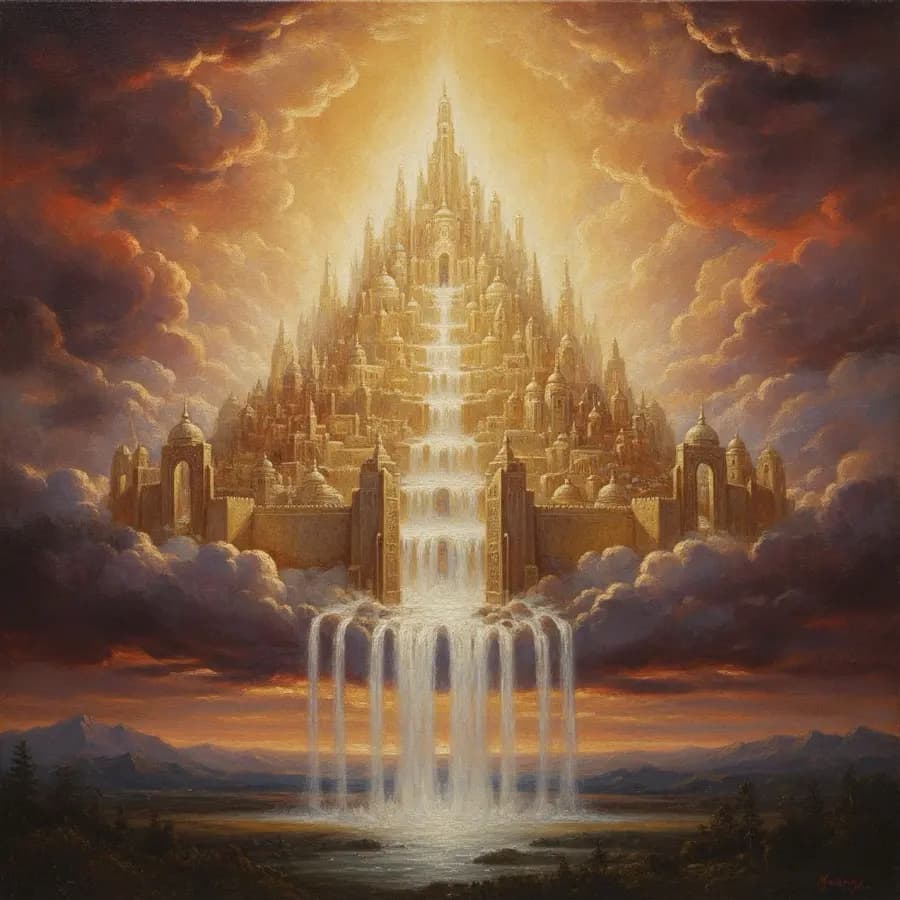
The New Jerusalem (Revelation 21-22)
The climax of Revelation, and of the entire Bible:
"And I heard a loud voice from the throne saying, 'Look! God's dwelling place is now among the people, and he will dwell with them. They will be his people, and God himself will be with them and be their God. He will wipe every tear from their eyes. There will be no more death or mourning or crying or pain, for the old order of things has passed away.'" (Revelation 21:3-4)
This is not simply an escape from earth. It is the renewal of all things, the final undoing of every consequence of the fall, and God dwelling with his people in a restored creation.
The Core Message of Revelation
Underneath all the imagery, Revelation is saying one thing to its original persecuted readers:
God sees what you are suffering. The powers that oppress you are not ultimate. Christ has already won the decisive victory. Hold on.
The book was not primarily a prophecy manual for twenty-first-century readers. It was a lifeline for first-century Christians who were watching friends die for their faith.
For modern readers, its enduring message is the same: the empire of this world, whatever form it takes, does not have the final word. The final word belongs to the One seated on the throne.
A Note on End-Times Interpretation
Christians disagree significantly about Revelation's relationship to the future:
- Dispensationalist/futurist views (common in American evangelical culture) read most of Revelation as predicting specific future events: the rapture, the tribulation, the mark of the beast, etc.
- Preterist views read most of Revelation as describing the events of the Jewish-Roman War (66-70 AD) and early Christian persecution
- Historicist views read Revelation as mapping church history
- Idealist views read it as timeless spiritual symbolism
Sincere, careful Christians hold all of these positions. The disagreements are genuine. What all approaches share: the book ends with God winning, evil ending, and creation being made new.
Read and Listen to Revelation
BibleNow lets you read the full text of Revelation, listen to any of its chapters, and save the verses that stay with you. Lumi, the BibleNow companion that answers your questions about the Bible, can help you explore specific passages, symbols, and their interpretive history.
Frequently asked questions
What is the Book of Revelation about?
The Book of Revelation is a letter written by the apostle John to seven real churches in Asia Minor (modern Turkey) who were facing persecution under Roman rule. It is written in 'apocalyptic' genre, a type of symbolic, visionary literature common in the ancient world that used coded imagery to communicate about present realities and future hope. Its core message: God is sovereign, evil will not win, Christ is victorious, and the suffering of God's people is not meaningless. Despite centuries of speculation about specific end-times timelines, most biblical scholars understand Revelation primarily as a message of encouragement to its original audience.
What do the main symbols in Revelation mean?
Many of Revelation's symbols would have been recognizable to first-century readers: 'Babylon' almost certainly refers to Rome; 'the beast' likely represents the Roman imperial system and possibly specific emperors (Nero is a common candidate for 666/616); the number 7 represents completeness throughout; the four horsemen represent conquest, war, famine, and death, common features of imperial oppression. The 144,000 is widely understood as a symbolic number representing the complete people of God, not a literal count. The New Jerusalem in Revelation 21-22 represents the ultimate restoration of creation and the dwelling of God with his people.
What does 666 mean in Revelation?
Revelation 13:18 introduces 'the number of the beast' as 666, calling it 'the number of a man.' The most common scholarly interpretation uses gematria (assigning numerical values to letters) to read 666 as a coded reference to the Emperor Nero (in Hebrew letters, 'Neron Caesar' = 666; in Latin letters, 'Nero Caesar' = 616, which is the number in some manuscripts). The practical meaning for original readers: the beast (the Roman imperial system demanding worship) is powerful but ultimately falls short. In broader application, 666 represents human systems that demand the allegiance that belongs only to God.
What are the main interpretations of Revelation?
Four main interpretive approaches: (1) Preterist: most of Revelation was fulfilled in first-century events (the fall of Jerusalem in 70 AD, Roman persecution); (2) Historicist: Revelation traces the whole course of church history; (3) Futurist: most of Revelation describes literal future events at the end of history (this is where most popular prophecy books fall); (4) Idealist: Revelation is not tied to specific historical events but depicts timeless spiritual realities. Most mainstream biblical scholars lean toward a preterist or historicist reading for the majority of the book, with the final chapters (20-22) addressing the ultimate future.

Live it in BibleNow
Listen to Bible stories with their painting, read Scripture on paper or at night, and ask Lumi anything.