What We Think We Know vs. What the Bible Says
Most of what most people "know" about the Christmas story comes from a mixture of the Bible and centuries of tradition, art, carols, and pageantry. The two get blended together until it's hard to separate them.
Here is the honest, careful reading of what the Bible actually says, and what it doesn't. Understanding the difference doesn't diminish the story. It often makes it more remarkable.
Two Accounts, Two Perspectives
The birth of Jesus is recorded in two Gospels, Matthew and Luke, and they approach it from different angles:
- Matthew focuses on Joseph, on Old Testament prophecy fulfillment, and on the magi who came after the birth
- Luke focuses on Mary, on the angelic announcement to the shepherds, and on the detailed sequence of events surrounding the birth
They are not contradictory. They are complementary portraits from different vantage points, like two witnesses describing the same event from different positions in the room.
Luke 1-2: The Story From Mary's Side
The Annunciation (Luke 1:26-38)
The angel Gabriel came to Mary in Nazareth. She was a young woman, likely engaged to Joseph; the age of marriage in that culture was typically 12 to 14. Gabriel's greeting was startling: "Greetings, you who are highly favored! The Lord is with you."
Mary's response ("How will this be, since I am a virgin?") is notable for its directness. She doesn't doubt the message; she asks the mechanism. Gabriel's answer: "The Holy Spirit will come on you, and the power of the Most High will overshadow you. So the holy one to be born will be called the Son of God."
Mary's response is one of the most beautiful in Scripture: "I am the Lord's servant. May your word to me be fulfilled." She said yes to something that would cost her everything socially: an unmarried pregnant woman in first-century Judea faced accusation, divorce (at minimum), and potentially death. Her yes was not cheap.
The Journey to Bethlehem (Luke 2:1-7)
Caesar Augustus issued a decree for a census. This brought Joseph and the heavily pregnant Mary from Nazareth in Galilee to Bethlehem in Judea, a journey of approximately 90 miles, likely taking 4 to 7 days on foot or by donkey.
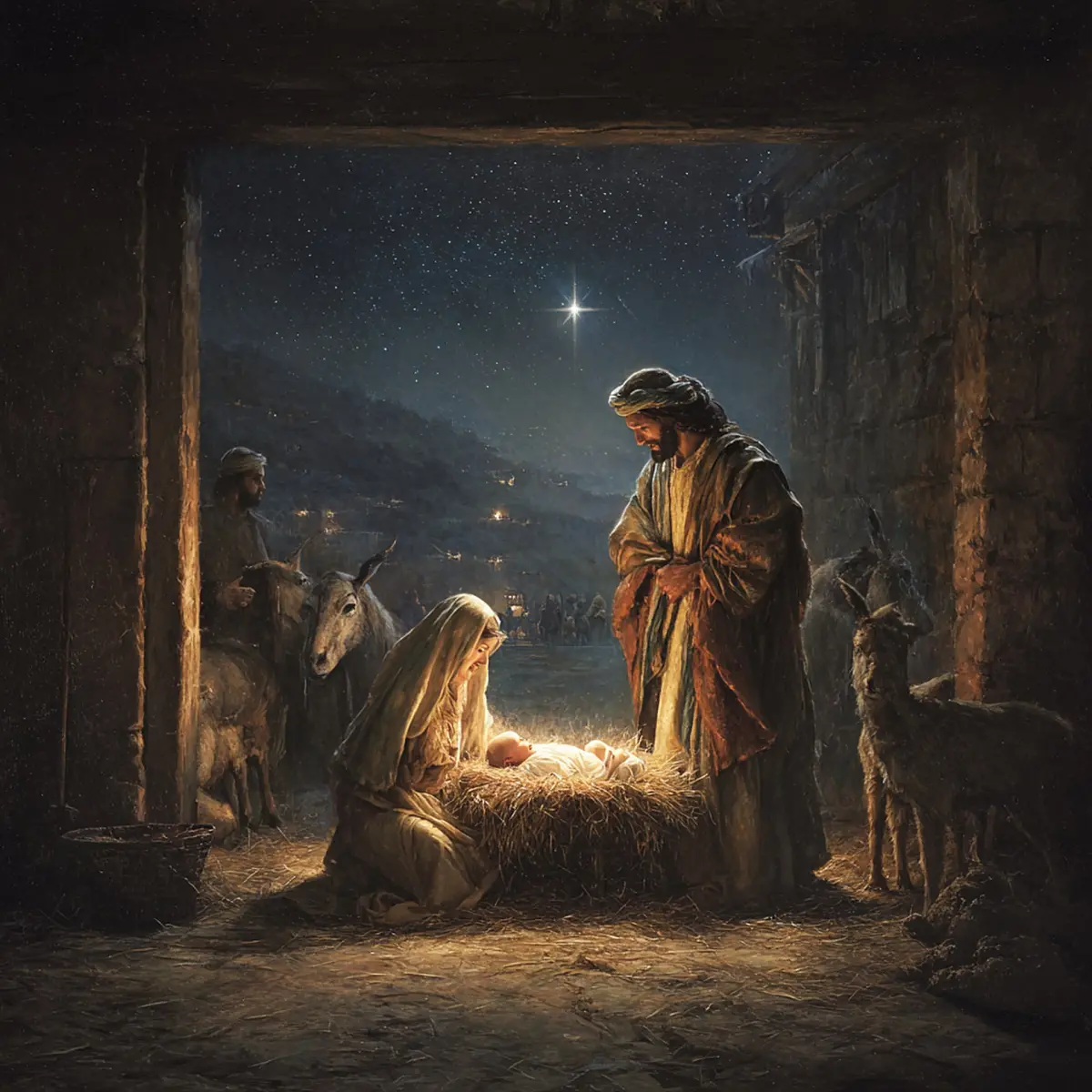
"While they were there, the time came for the baby to be born, and she gave birth to her firstborn, a son. She wrapped him in cloths and placed him in a manger, because there was no guest room available for them." (Luke 2:6-7)
The word is kataluma, not pandocheion (inn). Kataluma refers to a guest room in a private home. The same word is used in Luke 22:11 for the "upper room" of the Last Supper. This detail suggests Joseph's relatives in Bethlehem had a full guest room, and the family was accommodated in the main living space, where animals were kept at night and mangers (feeding troughs) were built into the floor.
There is no innkeeper in Luke 2. There is no "no vacancy" sign. There is a family making space in the most humble part of their home for the birth of the Son of God.
The Shepherds (Luke 2:8-20)
While the birth was happening, shepherds were in nearby fields "keeping watch over their flocks at night." An angel appeared and the "glory of the Lord shone around them", and they were terrified.
"Today in the town of David a Savior has been born to you; he is the Messiah, the Lord." (Luke 2:11)
The shepherds were at the bottom of the social hierarchy in first-century Israel. They couldn't observe Jewish purity laws while in the field; their testimony was not admissible in court. And yet they were the first announcement recipients. The angels bypassed the priests, the Pharisees, the political rulers, and told the shepherds.
Then the angel was joined by "a great company of the heavenly host, praising God and saying: 'Glory to God in the highest heaven, and on earth peace to those on whom his favor rests.'"
The shepherds went immediately, found the family, and told everyone. Mary "treasured up all these things and pondered them in her heart."
Matthew 1-2: The Story From Joseph's Side
Joseph's Dilemma (Matthew 1:18-25)
Matthew focuses on Joseph's experience. When he discovered Mary was pregnant, his plan was to "divorce her quietly": he was a righteous man who didn't want to disgrace her publicly. An angel appeared to him in a dream with the same message as Gabriel to Mary: "What is conceived in her is from the Holy Spirit."
The angel quoted Isaiah 7:14: "The virgin will conceive and give birth to a son, and they will call him Immanuel (which means 'God with us')." (Matthew 1:23)
Joseph woke up and obeyed. He married Mary and "had no union with her until she gave birth to a son. And he gave him the name Jesus."
The Magi (Matthew 2:1-12)
"After Jesus was born in Bethlehem in Judea, during the time of King Herod, Magi from the East came to Jerusalem."
Several things to note:
- "After Jesus was born": the Magi came later, not to the stable
- Magi (magoi in Greek) were likely Zoroastrian astrologers from Persia or Babylon, not kings, not necessarily three, not named in the text
- They came to a house (Matthew 2:11): "On coming to the house, they saw the child with his mother Mary." Not a stable. Not a manger. A house. Jesus may have been a year or two old by this point.
- Herod ordered the killing of "all the boys in Bethlehem and its vicinity who were two years old and under, in accordance with the time he had learned from the Magi" (Matthew 2:16), which suggests Jesus was up to 2 years old when the Magi arrived.
The three gifts (gold, frankincense, myrrh) gave rise to the tradition of three magi, but Matthew doesn't specify the number.
The Prophetic Background
Matthew's account is particularly focused on demonstrating that Jesus' birth fulfilled specific Old Testament prophecy:
| Prophecy | Reference | Fulfillment |
|---|---|---|
| Born of a virgin | Isaiah 7:14 | Matthew 1:22-23 |
| Born in Bethlehem | Micah 5:2 | Matthew 2:4-6 |
| Called out of Egypt | Hosea 11:1 | Matthew 2:15 |
| The slaughter of the innocents | Jeremiah 31:15 | Matthew 2:17-18 |
What Isaiah 7:14 Actually Said
Isaiah 7:14 is one of the most debated prophecy passages in the Bible. In its original context, Isaiah was speaking to King Ahaz about a sign in his own time. The Hebrew word used is almah, meaning a young woman of marriageable age. The Greek translation of the Old Testament (the Septuagint) translated this as parthenos, virgin.
Matthew quotes the Septuagint version. Christians understand this as a dual fulfillment: a partial fulfillment in Isaiah's time and a complete fulfillment in the virgin birth of Jesus. The theological weight is enormous: God became human, and his birth was announced centuries in advance.
What Micah 5:2 Said
Micah 5:2, written 700 years before Jesus: "But you, Bethlehem Ephrathah, though you are small among the clans of Judah, out of you will come for me one who will be ruler over Israel, whose origins are from of old, from ancient times."
When the chief priests and teachers of the law were asked where the Messiah was to be born, they answered immediately: Bethlehem (Matthew 2:4-5). The prophecy was well known.
The Two Genealogies: Why Are They Different?
Matthew's Gospel begins with a genealogy (Matthew 1:1-17) tracing Jesus from Abraham through David to Joseph. Luke's Gospel includes a genealogy (Luke 3:23-38) that goes backward from Jesus all the way to Adam.
The two genealogies diverge after David. Several explanations exist:
- Matthew traces Joseph's biological/legal line (fulfilling the promise to David that a descendant would sit on the throne)
- Luke traces Mary's biological line (establishing Jesus' full human lineage)
- Or Matthew follows the legal royal succession while Luke follows the natural paternal line of Joseph through Nathan rather than Solomon
Both genealogies serve theological purposes: Matthew grounds Jesus in the covenant history of Israel; Luke grounds him in the full human family ("son of Adam, son of God", Luke 3:38).
What Emmanuel Means for Us
The name declared over Jesus at his birth (Emmanuel, "God with us") is the entire gospel in two words.
Not God above us, though he is. Not God watching us from a distance, though he sees. Not God sending instructions, though he has. But God with us. Present. Embodied. Here.
The incarnation, the eternal Son of God taking on human flesh, is the hinge point of all history. C.S. Lewis called it "the central event in the history of the Earth." The God who spoke the universe into existence became a helpless baby in a borrowed feeding trough. That is the Christmas story. Nothing about tradition adds to it.
Reading Luke 2 Aloud as a Family
One of the most enduring Christmas traditions is reading Luke 2 aloud together. If you want to do this, open to Luke 2:1 and read through verse 20. It takes approximately 3 minutes. It is the actual story, with the census, the journey, the manger, the shepherds, and the angels. It is complete and beautiful and enough.
Explore Matthew 1-2 and Luke 1-2 in depth with BibleNow: https://biblenow.onelink.me/7rjl/z8us8bll
Frequently asked questions
Where is the Christmas story in the Bible?
The birth of Jesus is recorded in two places: Matthew 1:18-2:23 and Luke 1:26-2:40. They are complementary, not contradictory: Matthew focuses on Joseph's perspective and the magi who came later, while Luke focuses on Mary's perspective and the shepherds. John 1:1-14 provides the theological prologue: 'The Word became flesh and made his dwelling among us.' Mark and John do not include a birth narrative.
Were there really three wise men at the manger?
The Bible never says 'three wise men.' Matthew 2:1 says 'Magi from the East came to Jerusalem.' The number three is inferred from three gifts (gold, frankincense, myrrh). The word 'magi' refers to astrologers or scholars from the East, likely Persia or Mesopotamia. They were not present at the manger; Matthew 2:11 says they came to a 'house,' and Herod's order to kill children 'two years and under' suggests Jesus may have been a toddler when they arrived.
Was Jesus born in a stable?
Luke 2:7 says Jesus was placed in a manger 'because there was no guest room available for them.' The Greek word is kataluma, the same word used in Luke 22:11 for the upper room of the Last Supper, meaning a guest room, not an inn. Many scholars now believe Mary and Joseph were in a family member's home in Bethlehem (since Joseph was returning to his ancestral town), and the main guest room was full, so Jesus was born in the lower portion of the house, where animals were kept at night. The 'stable' is a later tradition.
Was Jesus born on December 25?
The Bible does not give a specific date for Jesus' birth. December 25 was established as the celebration date by the Roman church in the 4th century. Some scholars argue that the presence of shepherds in the fields at night (Luke 2:8) suggests a spring or fall birth (when sheep were pastured outdoors), not winter. The theological meaning of the incarnation is not affected by the calendar date.
What does 'Emmanuel' mean in the Christmas story?
In Matthew 1:23, Jesus is identified as the fulfillment of Isaiah 7:14: 'The virgin will conceive and give birth to a son, and will call him Immanuel', from the Hebrew meaning 'God with us' (immanu = with us, el = God). This is not a common name Jesus was called in daily life; it is a theological title that declares what his birth means. The entire Christmas story is contained in this word: God chose to be with us, in person, in flesh.

Live it in BibleNow
Listen to Bible stories with their painting, read Scripture on paper or at night, and ask Lumi anything.