Earth Day and the Bible
Earth Day is April 22. Every year it brings recycling campaigns, climate conversations, and nature posts flooding social media.
But long before Earth Day existed (thousands of years before), the Bible was already talking about the relationship between humans and the natural world. Not as a political statement. As a theological one.
Here is what Scripture actually says.
The Foundation: God Owns the Earth
Before any conversation about caring for the earth, the Bible establishes one fact clearly:
"The earth is the Lord's, and everything in it, the world, and all who live in it." (Psalm 24:1)
This one verse reframes everything. The earth is not humanity's possession. It belongs to God. That means how we treat it is not a lifestyle choice. It is a reflection of how we relate to its owner.
This is the theological root of what Christians call creation care.
Genesis: The Original Mandate
The creation account in Genesis gives humans a specific role:
"Then God said, 'Let us make mankind in our image, in our likeness, so that they may rule over the fish in the sea and the birds in the sky, over the livestock and all the wild animals, and over all the creatures that move along the ground.'" (Genesis 1:26)
The word "rule" (Hebrew: radah) has sometimes been read as license to exploit. But the very next chapter clarifies what that rule looks like in practice:
"The Lord God took the man and put him in the Garden of Eden to work it and keep it." (Genesis 2:15)
"Keep" in Hebrew is shamar: to guard, preserve, watch over. It is the same word used when God tells Abraham to "keep" his covenant. It implies faithful, protective stewardship, not domination.
Humans are placed in creation as caretakers. That is the original job description.
10 Bible Verses for Earth Day
These are the passages worth sitting with on April 22:
1. Psalm 104:24-25
"How many are your works, Lord! In wisdom you made them all; the earth is full of your creatures. There is the sea, vast and spacious, teeming with creatures beyond number."
God delights in the diversity of his creation. This psalm is an entire poem celebrating the natural world.
2. Proverbs 12:10
"A righteous man cares for the needs of his animal, but the kindest acts of the wicked are cruel."
Care for living creatures is a marker of righteousness. It is not optional or secondary.
3. Romans 8:19-21
"For the creation waits in eager expectation for the children of God to be revealed... in hope that the creation itself will be liberated from its bondage to decay."
Paul frames creation as something groaning and waiting. It is not disposable. It has a future in God's redemptive plan.
4. Nehemiah 9:6
"You alone are the Lord. You made the heavens, even the highest heavens, and all their starry host, the earth and all that is on it, the seas and all that is in them. You give life to everything."
Creation is God's personal work. Every living thing owes its existence to him.
5. Job 12:7-10
"But ask the animals, and they will teach you, or the birds in the sky, and they will tell you... In his hand is the life of every creature and the breath of all mankind."
Nature itself testifies to God. The animals and birds are not just resources. They are witnesses.
6. Leviticus 25:23-24
"The land must not be sold permanently, because the land is mine and you reside in my land as foreigners and strangers."
Even in property law, God reminds Israel: you are tenants, not owners. The land belongs to him.
7. Isaiah 24:4-5
"The earth dries up and withers, the world languishes and withers, the heavens languish with the earth. The earth is defiled by its people; they have disobeyed the laws, violated the statutes and broken the everlasting covenant."
One of the clearest connections in Scripture between human sin and environmental consequence. Isaiah wrote this 2,700 years ago.
8. Matthew 6:26
"Look at the birds of the air; they do not sow or reap or store away in barns, and yet your heavenly Father feeds them. Are you not much more valuable than they?"
Jesus points to birds as evidence of God's provision. He could not do that if birds were irrelevant to God.
9. Colossians 1:16-17
"For in him all things were created: things in heaven and on earth, visible and invisible... all things have been created through him and for him. He is before all things, and in him all things hold together."
Creation is not an accident or backdrop. It was made through Christ and for Christ. That gives it intrinsic worth.
10. Revelation 11:18
"...The time has come for judging the dead... and for destroying those who destroy the earth."
In the final accounting, destroying the earth is listed alongside things God judges. That is a striking final word on how seriously Scripture treats creation.
What Is "Creation Care"?
Creation care is the theological term for the Christian responsibility to protect and steward the natural world. It is not about politics. It is about:
- Recognizing that creation belongs to God, not us
- Taking seriously the Genesis mandate to "keep" the garden
- Reflecting God's character through how we treat what he made
- Understanding that how we treat creation is connected to how we treat the Creator
It shows up differently in different traditions: some Christians emphasize individual choices, others focus on systemic change. But the biblical foundation is the same across all of them.
The Tension: Dominion vs. Stewardship
Some Christians resist creation care because of the word "dominion" in Genesis 1:26. But the two concepts are not opposites.
Dominion in the biblical sense is modeled on God's own rule, which is characterized by care, provision, and love for what he made. A king who destroys his kingdom is not exercising dominion. He is failing it.
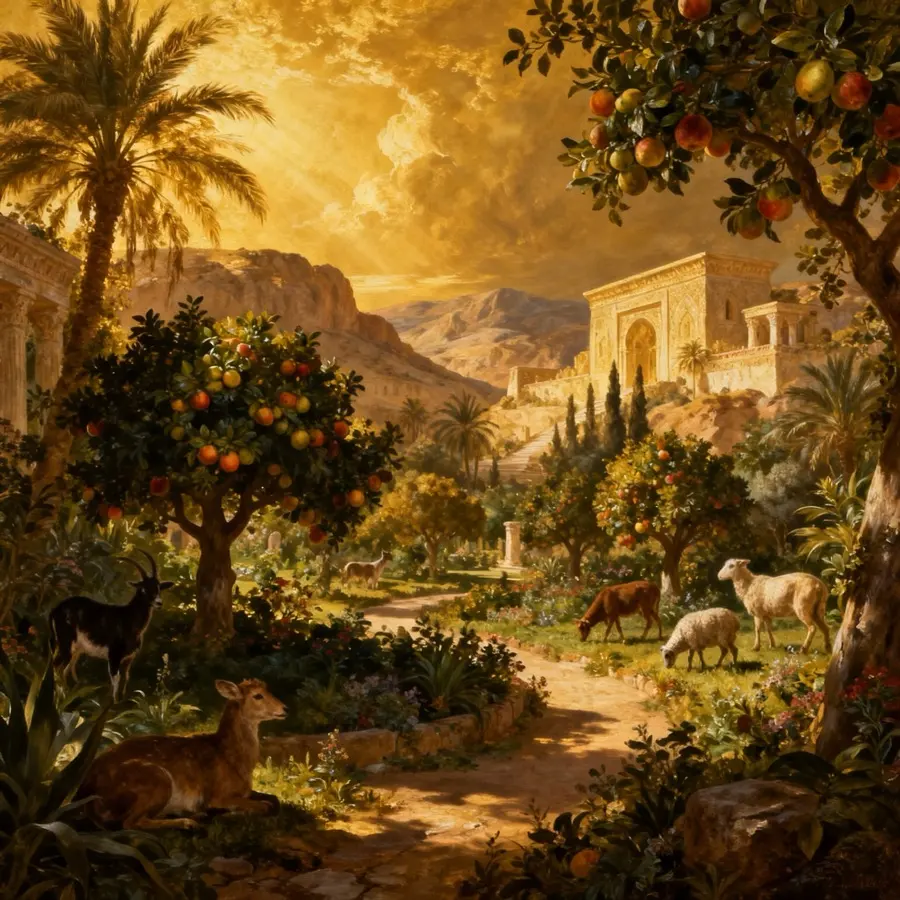
The Garden of Eden is the picture: humans placed in abundance, given meaningful work, and charged with keeping what God made beautiful.
A Simple Practice for Earth Day
If you want to mark Earth Day with something grounded in Scripture rather than just hashtags:
-
Read Psalm 104 slowly. It is a complete celebration of creation: mountains, springs, wild animals, the moon and seasons. Read it outside if you can.
-
Pray Nehemiah 9:6. Acknowledge God as the maker and sustainer of everything living. Let that reframe how you see the world around you today.
-
Ask one question. Open BibleNow and ask Lumi, the companion that answers your Bible questions: "What does the Bible say about caring for creation?" You will get a clear answer with verses from across Scripture.
Try it free: https://biblenow.onelink.me/7rjl/z8us8bll
Creation Care Is Not a Political Statement
It is worth saying directly: this is not a partisan issue in Scripture. Isaiah's warnings about the earth drying up were written to a culture that knew nothing of modern politics. The Psalms celebrating creation were songs of worship, not policy papers.
Christians across the spectrum agree on the foundation: the earth belongs to God, humans are stewards, and faithfulness includes how we treat what we were given to keep.
Earth Day is a useful annual moment to reconnect with that foundation: to step back from the noise and return to what Genesis established first.
Happy Earth Day. "The earth is the Lord's, and everything in it." (Psalm 24:1)
Frequently asked questions
Does the Bible say anything about Earth Day or the environment?
Not Earth Day specifically, since it is a modern observance. But the Bible speaks extensively about creation, humanity's responsibility to care for it, and God's ownership of the natural world. Genesis, Psalms, and Proverbs are full of relevant passages.
What is the main Bible verse about caring for the earth?
Genesis 2:15 is the clearest: 'The Lord God took the man and put him in the Garden of Eden to work it and keep it.' The word 'keep' in Hebrew (shamar) means to guard, protect, and preserve.
What does 'stewardship' mean in a biblical context?
Stewardship means managing something that belongs to someone else. In the Bible, humans are stewards of the earth: caretakers of what ultimately belongs to God (Psalm 24:1).
Is caring for the environment a Christian responsibility?
Many theologians say yes. The concept of 'creation care' is rooted in the Genesis mandate and developed throughout Scripture. Christians are called to reflect God's character, which includes caring for what He made.
How can I explore these Bible verses in more depth?
Lumi, the BibleNow companion that answers your questions about the Bible, lets you ask about any verse: its context, meaning, and application. You can ask 'What does Genesis 1 say about creation?' and get a clear answer with verses to read. Lumi uses AI and gives you 2 free questions a day.

Live it in BibleNow
Listen to Bible stories with their painting, read Scripture on paper or at night, and ask Lumi anything.